.jpg)

WA Building Audits 2026–27: What Owner Builders Need to Know
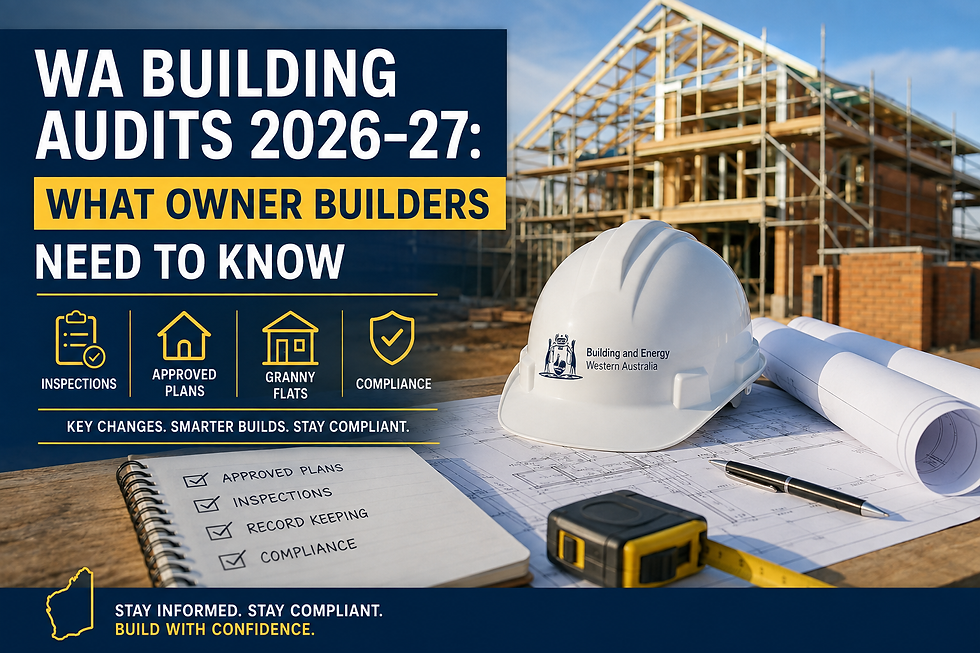
Western Australia’s Building and Energy regulator has released its 2026–27 Proactive Audit Priorities, outlining where it will focus its compliance and inspection activities across the building industry over the coming year.
The proactive audit program is intended to identify emerging compliance risks, strengthen accountability and promote higher standards of building practice throughout Western Australia.
While the audit program is primarily directed at registered building contractors, building surveyors and building engineers, several of the announced priorities are particularly relevant to people planning or managing residential construction projects — including WA owner builders.
These include residential building inspections, compliance with approved plans, performance solutions and ancillary accommodation such as granny flats.
If you're planning to manage your own building project, understanding your WA owner builder requirements before construction starts can make the entire process easier to manage.
So, what should WA owner builders take from the 2026–27 announcement?
1. Residential Building Projects Will Be Inspected at Key Stages
One of Building and Energy’s priorities for 2026–27 is inspecting residential building projects at key stages of construction.
According to the regulator, these inspections will assess whether work is being carried out in accordance with:
approved plans;
relevant standards; and
legislative requirements.
For an owner builder, this reinforces an important point: obtaining approval to build is only one part of managing a compliant project.
The work actually carried out on site needs to remain consistent with the approved documentation and applicable building requirements throughout construction.
This is one reason our WA Owner Builder Course covers not only the owner-builder approval process, but also reading plans, site management, construction sequencing, inspections and completion.
Changes made during construction should not automatically be treated as informal site decisions.
If you want to change a material, structural detail, layout or another element of the approved design, consider whether the change needs to be reviewed by your building surveyor, engineer, designer, local government or another relevant professional before the work proceeds.
2. Approved Plans Matter — Keep Everyone Working From the Right Documents
Owner builders can find themselves coordinating several trades and contractors over the course of a project.
That makes document control particularly important.
Your approved drawings, specifications, engineering details and other project documentation provide the basis for what is intended and approved to be constructed.
Building and Energy has specifically identified whether completed residential building work aligns with approved designs as an area of compliance activity for 2026–27.
For owner builders, some sensible project-management practices include:
keeping the current approved plans and specifications readily accessible;
making sure trades are working from the latest relevant documents;
retaining engineering drawings and details;
documenting variations and design changes;
keeping inspection and certification records; and
seeking professional advice before proceeding with a change where you are unsure whether further approval or documentation is required.
Understanding plans and drawings is also an important part of preparing to manage your own project. Our online WA owner builder training includes a dedicated module on reading and interpreting building plans and drawings, along with the WA building permit process.
It is much easier to maintain good records as your project progresses than to try to reconstruct the history of a build months or years later.
3. Granny Flats Are Specifically Included in the 2026–27 Priorities
One of the most relevant parts of the announcement for residential property owners is the inclusion of ancillary accommodation, commonly referred to as granny flats.
Building and Energy says it will examine whether ancillary accommodation projects comply with applicable standards and approval requirements.
This is particularly relevant to owner builders because WA owner-builder work can include constructing a detached dwelling, including a granny flat, where the applicable owner-builder and project requirements are met.
If you're considering taking this route, our guide to becoming an owner builder in WA explains the types of projects owner builders can undertake and the approval pathway involved.
A smaller secondary dwelling should not be treated as meaning that normal building and approval requirements no longer apply.
Depending on the particular project and property, planning, building, design and technical requirements may need to be addressed before and during construction.
If you're considering building a granny flat, make sure you establish the requirements that apply to your particular property and proposed design before starting work.
4. Performance Solutions Are Also Under the Spotlight
Building and Energy has also identified performance solutions used in residential building approvals as an area of focus.
The regulator will examine performance solutions and whether completed building work aligns with the approved design.
What is a Performance Solution?
Under the National Construction Code (NCC), there are different pathways for demonstrating that a building design satisfies the required Performance Requirements.
A Performance Solution is a compliance solution that differs in whole or in part from a Deemed-to-Satisfy Solution.
For an owner builder, you don't necessarily need to become an expert in the technical assessment of performance solutions.
What is important is understanding that where your project's approval relies on a particular design, specification, engineering detail or documented solution, the work constructed on site needs to reflect what was assessed and approved.
If you are considering changing a component, material or construction detail, don't simply assume the alternative is equivalent.
Where appropriate, check with the relevant building professional before making the change.
Learning how approvals, plans and construction responsibilities fit together is an important part of preparing for an owner-builder project. You can see what's covered in our WA Owner Builder Course and Form 75 training.
5. Good Record-Keeping Can Make Managing Your Build Much Easier
Owner building involves considerably more than organising trades and purchasing materials.
In Western Australia, owner builders take on significant responsibilities for managing and supervising their building project.
Maintaining organised project records can help you keep track of what was approved, what was constructed and what decisions were made throughout the build.
A useful owner-builder project file may include:
Document Category | Examples of Records to Keep |
Approvals & Permits | Building permit, approved plans, applicable planning approvals and approval conditions |
Plans & Specifications | Current drawings, specifications, schedules and relevant design documentation |
Engineering & Technical Documents | Engineering drawings, reports, calculations and documented performance solutions relevant to the project |
Trade Documentation | Contracts, quotes, invoices and certificates or compliance documentation where applicable |
Inspections | Inspection reports, records and relevant correspondence |
Variations & Changes | Revised drawings, approved variations and correspondence relating to design or construction changes |
Project Communications | Important emails and written instructions involving trades, designers, engineers, surveyors and other project professionals |
The exact documents required will depend on your project, but establishing an organised filing system from the beginning can save significant time later.
This practical side of managing a build is why the Owner Builder Institute WA course also covers contracts, quotes, budgets, progress payments, site management, inspections and completion — not just the initial approval application.
6. What Are WA Owner Builders Responsible For?
The new audit priorities don't change the fundamental responsibilities of a WA owner builder.
As an owner builder, you take on significant responsibility for managing and supervising your project. This can include:
obtaining and complying with required permits;
managing and supervising the project;
scheduling and coordinating trades;
maintaining site safety;
monitoring the quality of work;
obtaining required inspections and certification;
addressing defective work; and
understanding the insurance requirements that apply to your project.
Engaging qualified trades and professionals does not mean the owner builder can simply disengage from the project.
Instead, a major part of being an owner builder is knowing what needs to happen, who should carry it out and when professional assistance is required.
If you're still at the planning stage, our WA owner builder course online takes you through these responsibilities before you start managing construction.
7. Applying for Owner-Builder Approval in WA
Before you can undertake owner-builder work that requires approval, you need to understand the WA owner-builder application process.
For many applicants, this includes demonstrating sufficient knowledge of an owner builder's duties and responsibilities and lodging the required information with Building and Energy.
Owner Builder Institute's WA Owner Builder Course is 100% online and self-paced, with WA-specific content designed around the knowledge required for the Form 75 owner-builder approval process.
The course currently includes 10 modules covering:
becoming an owner builder in WA;
what owner builders can and cannot build;
owner-builder approval and Form 75;
the WA building permit process;
reading and interpreting plans;
contracts, quotes, budgets and progress payments;
WHS duties and construction safety;
insurance and selling obligations;
site management and construction sequencing; and
inspections and project completion.
You can also read our full WA owner builder permit and Form 75 information before deciding whether the owner-builder pathway is right for your project.
8. What Do the 2026–27 Audit Priorities Mean for Your Build?
The announcement shouldn't be interpreted as Building and Energy announcing a new audit program specifically targeting owner builders.
The stated proactive audit program focuses on registered building contractors, building surveyors and building engineers.
However, the areas Building and Energy has chosen to prioritise provide a useful indication of the compliance issues receiving regulatory attention across WA's building industry.
For owner builders, there is a clear practical takeaway:
Know what has been approved, keep good records, communicate changes properly and make sure the work being constructed reflects the documentation applicable to your project.
The 2026–27 priorities reinforce the connection between what was designed, what was approved and what was actually built.
That's a principle worth carrying through every stage of an owner-builder project.
Planning to Owner Build in WA?
Taking on an owner-builder project can give you greater involvement and control over your build, but it also comes with significant responsibilities.
The Owner Builder Institute WA Owner Builder Course is designed specifically for people preparing to take on an owner-builder project in Western Australia.
The course is:
100% online and self-paced
WA-specific
10 modules
designed around WA Form 75 requirements
supported by practical owner-builder resources
completed by most students in approximately 2–4 hours
followed by a same-day certificate on completion
Rather than treating owner-builder education as simply a box to tick, our aim is to help you understand the project you are about to manage.
Source: Building and Energy, Department of Local Government, Industry Regulation and Safety — Proactive Audit Priorities Statement 2026–27.
This article provides general educational information only and does not constitute legal, building, planning, engineering or other professional advice. Requirements vary according to the property, project and circumstances. Always confirm the requirements applicable to your project with the relevant authority or appropriately qualified professional.

Comments