.jpg)

Owner Builder Process: From Planning to Permit to Construction

Understand the owner builder process in Australia, from early planning and approvals through permits, trades, construction and final certification.
Becoming an owner builder gives you the opportunity to take greater control over your building project, but it also means taking responsibility for many of the tasks normally managed by a licensed builder.
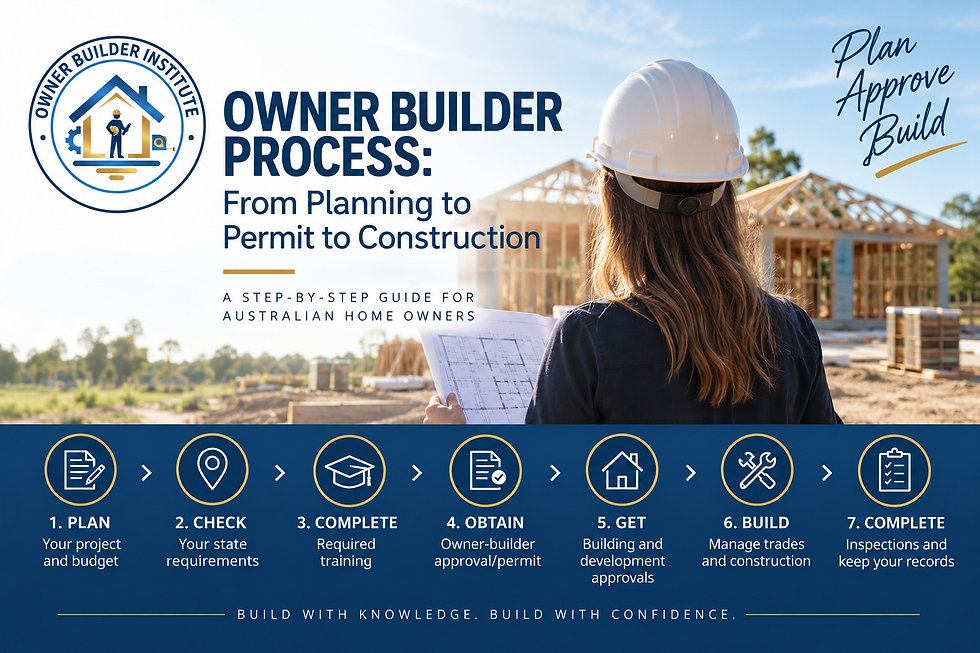
The owner builder process generally starts well before construction begins. You may need to confirm planning requirements, prepare plans and costings, obtain the required owner-builder approval or permit, organise building approval, engage appropriately licensed trades and manage construction through to inspections and completion.
The exact process varies between Australian states and territories, so understanding the steps that apply where you're building is an important place to start.
What Is an Owner Builder?
An owner builder is generally a property owner who takes responsibility for managing or supervising building work on their own property rather than engaging a licensed builder to manage the entire project.
That doesn't necessarily mean physically building the whole house yourself.
For many owner builders, the role is closer to being the project manager or head contractor. You may organise trades, obtain quotes, schedule work, monitor costs and make sure the project progresses in accordance with its approvals.
For example, Queensland's QBCC describes an owner builder as taking on the role of head contractor and being responsible for engaging, coordinating and scheduling contractors.
The Owner Builder Process at a Glance
Although requirements differ across Australia, an owner-builder project will commonly involve:
Planning → plans and costings → check owner-builder requirements → complete required training → obtain owner-builder approval or permit → obtain building/development approvals → engage trades → construction → inspections → completion and certification
One of the most important things to understand is that owner-builder approval and building approval are not necessarily the same thing.
For example, in Western Australia, owner-builder approval is required before applying to the relevant local government for a building permit where the owner-builder requirements apply.
Let's look at the process in more detail.
Step 1: Plan Your Project
Before submitting applications or booking trades, work out exactly what you intend to build.
Depending on the project, this may involve:
establishing your budget
preparing concept plans
checking your property title and site constraints
considering planning requirements
obtaining surveys or engineering information
identifying services and site access
estimating the value of the work
determining which approvals may be required
This early stage is also where a realistic budget becomes important.
Your budget should account for more than the obvious materials and trade quotes. Depending on your project, you may also need to allow for consultants, engineering, approvals, inspections, temporary works, waste removal, equipment hire, site works and contingencies.
Step 2: Check the Owner Builder Rules in Your State or Territory
There isn't one national owner-builder permit system.
Each state and territory sets its own rules about who can become an owner builder, when approval or a permit is required, what training applies and what types of projects can be undertaken.
For example, current requirements include:
Western Australia: Owner-builder approval may be required where a building permit is required and the estimated value exceeds $20,000. For Class 10a buildings such as sheds, carports and private garages, the threshold is $50,000.
Queensland: An owner-builder permit is generally required if you want to undertake or supervise a building project valued at more than $11,000, including GST, subject to the rules and exceptions applying to the project.
New South Wales: An owner-builder permit is generally required when you want to supervise or undertake residential building work valued at more than $10,000 and aren't contracting a licensed builder to supervise the work. Additional education requirements apply where the work exceeds $20,000.
Other jurisdictions have their own requirements, so always check the current rules for the location of your project before proceeding.
Step 3: Complete Any Required Owner Builder Training
Depending on your state, project and circumstances, you may need to complete training before obtaining owner-builder approval.
Training requirements aren't identical around Australia.
In WA, for example, an applicant must demonstrate sufficient knowledge of owner-builder duties and responsibilities. One pathway is completing appropriate WA-specific owner-builder training within the previous 24 months, together with the applicable construction induction card requirement.
In NSW, applicants for projects valued above $20,000 must meet the owner-builder education requirements or have an accepted equivalent qualification or experience, and owner-builder permit applicants must also hold the required construction induction card.
Planning an owner-builder project in Western Australia? Owner Builder Institute offers an online WA Owner Builder Course designed specifically around the knowledge requirements for WA owner-builder applications.
Step 4: Apply for Owner Builder Approval or a Permit
Once you've established that you're eligible and completed any applicable training, the next step may be obtaining your owner-builder approval or permit.
Exactly when this happens depends on your jurisdiction.
In WA, for example, owner-builder approval is obtained before applying to the local government for the building permit. Building and Energy currently advises that owner-builder approval typically takes around six weeks from a complete lodgement, though processing times can vary, so it's worth building some buffer into your project timeline. Once approval is granted, you generally have six months to apply for the building permit.
If you're building in WA, we've prepared a detailed guide to the application process:
Step 5: Obtain Your Building and Development Approvals
Being approved as an owner builder doesn't automatically give you permission to begin construction.
Your project may require separate planning, development and/or building approval.
The terminology and sequence vary between jurisdictions.
NSW illustrates the distinction clearly. Development consent may take the form of a Development Application (DA) approval or Complying Development Certificate (CDC), while construction approval may involve a Construction Certificate. NSW Government guidance states that an owner-builder permit isn't required to obtain development consent, but it is required before appointing a principal certifier and commencing owner-builder work where the permit requirements apply.
This is why it's important not to assume that receiving one approval means you're ready to start digging.
Step 6: Prepare for Construction
Once the necessary approvals are in place, the focus shifts from paperwork to actually organising the build.
Before work starts, an owner builder may need to coordinate:
site establishment
temporary fencing and site security
construction access
trade contractors
materials and deliveries
workplace health and safety requirements
insurance
waste management
required inspections
construction scheduling
Good organisation at this stage can prevent expensive delays later.
For example, having a concreter ready doesn't help if the preceding plumbing or inspection hasn't been completed.
A detailed construction schedule can help you identify these dependencies before they become problems.
Step 7: Engage Appropriately Licensed Trades
Being an owner builder doesn't give you unrestricted permission to carry out licensed trade work.
Some work must still be performed by appropriately licensed people.
NSW, for example, specifically states that an owner-builder permit does not authorise specialist work such as electrical, plumbing, gasfitting, air-conditioning or refrigeration work unless the owner builder separately holds the required licence.
The precise licensing requirements vary between jurisdictions, so check each contractor's licence and the rules applicable to the type of work before engaging them.
As the owner builder, you'll often be responsible for coordinating these contractors and making sure work occurs in the correct sequence.
Step 8: Manage the Construction
This is where the owner-builder role becomes very hands-on, even if you're not physically performing the trade work.
You may be coordinating:
excavation and earthworks
foundations and slabs
framing
roofing
plumbing and electrical stages
waterproofing
internal linings
cabinetry and fit-out
painting
external works
inspections and certifications
You will also need to monitor your budget as construction progresses.
Changes made during construction can have flow-on effects. Moving a wall, changing a window or altering a bathroom layout may affect several trades rather than just one.
Keeping accurate records of quotes, invoices, approvals, variations, certificates and contractor details throughout the project can make the process much easier to manage.
Step 9: Arrange Required Inspections
Building work usually involves inspections or certification at particular stages.
The exact stages depend on the jurisdiction, building approval and type of project.
Don't wait until the end of the build to work out what inspections were required.
Your building approval, certifier, building surveyor or local authority should identify the relevant inspection requirements. Make these part of your construction schedule so work isn't covered up before a required inspection takes place.
Step 10: Complete the Project and Keep Your Records
Finishing construction isn't simply a matter of the last contractor leaving the site.
Depending on the project and jurisdiction, there may still be final inspections, certificates, approvals or other completion requirements.
Keep your project documentation together, including relevant:
permits and approvals
approved plans
engineering documentation
contracts and quotes
invoices and receipts
trade licences and details
inspection records
certificates
warranties and manuals
These records may be important long after construction is complete, particularly if you later sell the property.
Is Owner Building Just a Way to Save Money?
Cost is certainly one reason people consider owner building, but it shouldn't be the only consideration.
Taking on the owner-builder role can provide greater control over quotes, materials, scheduling and some design decisions.
But you're also taking on significant responsibility.
Government guidance makes this particularly clear. NSW states that an owner builder is responsible for the building work just as a fully licensed builder would be, while WA states that an owner builder assumes the responsibilities, risks and liabilities of a professional builder.
So the better question isn't simply:
"Can I save money as an owner builder?"
It's:
"Am I prepared to manage the project properly?"
Start the Owner Builder Process Before You Start Building
A successful owner-builder project starts with planning, not construction.
Understand your state's requirements, establish your budget, organise your approvals, know which work requires licensed trades and have a system for managing your schedule and records.
Taking the time to get these foundations right can make the construction stage considerably easier to manage.
If you're preparing to owner build in Western Australia, Owner Builder Institute's online WA Owner Builder Course can help you work through the knowledge requirements relevant to the WA owner-builder approval process.


Comments