.jpg)

New Modelling Says the Federal Housing Package Will Cut 10,700 Homes — Here's What It Means If You're Planning to Build

Updated industry modelling on negative gearing and CGT changes points to fewer new homes and higher rents — and it's another reason more Australians are looking at owner building to take back control of their build.
On 11 September 2026, four of the country's peak property and construction bodies — Master Builders Australia, the Housing Industry Association (HIA), the Property Council of Australia, and the Real Estate Institute of Australia (REIA) — released updated independent modelling on the Federal Government's housing tax package.
The numbers are a further downgrade on modelling released straight after the Budget, and they matter to anyone thinking about building, renovating, or investing in property over the next few years — including people weighing up whether to become an owner builder rather than wait on a shrinking supply of new dwellings.
What the updated modelling found
The analysis, prepared by Qaive and Tulipwood Economics, looks at the combined effect of changes to negative gearing and capital gains tax concessions, the $2 billion Housing Support Program, and a new measure restricting self-managed super funds from using limited recourse borrowing to buy residential investment property.
Between 2026–27 and 2029–30, the modelling estimates the package will:
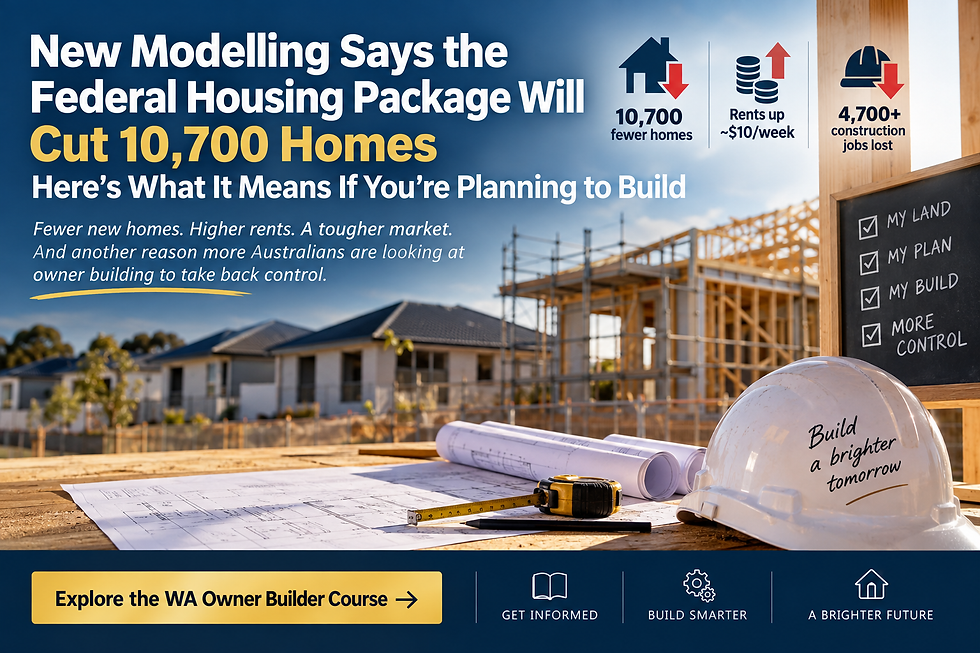
10,700 fewer new dwelling starts
Rents up by roughly $10 a week
Cumulative GDP down by about $1.05 billion
More than 4,700 construction jobs lost
The industry groups argue this is a step in the wrong direction for a country that has already set itself a target of 1.2 million new homes, and say the figures reinforce a simple point: it's harder to solve a housing shortage with policies that make it more expensive to finance and build homes.
Industry modelling vs the Government's own numbers
It's worth noting these figures come from modelling commissioned by industry bodies that oppose the tax changes, and the Government's own projections for the same package look very different. Here's how the two sides compare:
Measure | Industry modelling | Government's claim |
New homes / owner-occupiers | 10,700 fewer dwelling starts | ~75,000 additional owner-occupiers; up to 30,000 extra homes with other measures |
Rents | Up ~$10/week | Up less than $2/week for median rent |
House prices | Not separately quantified | Growth ~2% lower over several years |
The industry bodies say they'll keep tracking market data against these government targets as the changes take effect, so it's a space worth watching rather than treating either set of figures as the final word.
What this actually means if you're planning to build
Whichever set of numbers turns out closer to reality, the direction of travel is the same: new housing supply is under pressure, construction costs and finance conditions remain tight, and builder-delivered homes are only getting harder to come by at an affordable price.
That's exactly the environment where owner building becomes a genuinely attractive option. When you act as your own owner builder, you:
Manage your own trades and materials instead of paying a builder's margin on top of every cost
Have more control over your build timeline in a market where builder availability is stretched
Can make your own calls on where to spend and where to save, rather than being locked into a fixed contract price
Aren't competing for the same shrinking pool of project-home builder slots as everyone else
Of course, owner building comes with real responsibilities — most states require an owner builder permit, and you'll need to understand your obligations around contracts, insurance, and safety before you start. That's where getting properly informed up front pays off.
Thinking about becoming an owner builder in WA?
Get clear on your obligations before you apply for your permit.
The bottom line
Updated modelling from Master Builders Australia, HIA, the Property Council, and REIA points to fewer new homes, higher rents, and thousands of lost construction jobs under the current federal housing package — a sharper warning than the modelling released right after the Budget. The Government disputes the scale of the impact, and only time and real market data will settle who's closer to the mark.
In the meantime, for anyone with a block of land and a plan, owner building remains one of the few ways to keep more control over cost and timing in a construction market that's tightening from several directions at once.
Source: Joint Statement, Master Builders Australia, Housing Industry Association, Property Council of Australia and Real Estate Institute of Australia, 11 September 2026.


Comments